What made handwriting data reliable?
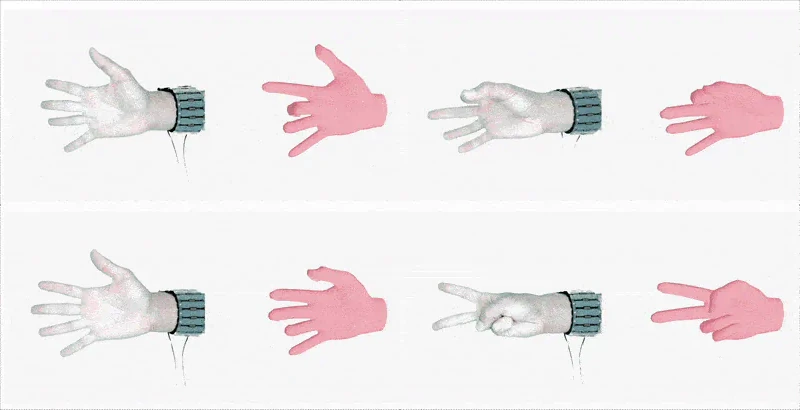
The wristband recorded electrical signals from muscle activity using surface electromyography (sEMG). Decoding models translated those signals into computer input. A misread character showed that recognition had failed. It did not explain why.
I needed to separate three questions: was this the participant’s natural writing, were they following the task, and were the collection conditions reliable?
Rejecting natural variation could remove useful training data; accepting compromised recordings could introduce unreliable evidence.

Evaluate behavior before judging the data.
I observed participants’ writing movements, compared them with the system’s recognized output, and asked about their usual handwriting and approach to the task. I considered these observations alongside collection conditions and brought unresolved concerns to research scientists and engineers.
Handwriting appearance alone was not enough.
-
Inconsistent handwriting needed context
When a participant’s writing movements appeared inconsistent, I asked whether they reflected their usual handwriting. When that context supported natural variation, I did not flag the writing style itself as a quality concern. The reliability of the recording remained a separate question.
-
More careful was not always more useful
Some participants wrote more carefully than they normally would. I reinforced the instruction to write naturally, helping keep the behavior aligned with what the study intended to capture.
A shared basis for deciding what needed review.
I contributed behavioral observations and participant context to discussions with research scientists and engineers, helping distinguish concerns about natural variation, task adherence, and recording quality.
These discussions informed shared review questions that helped explain why a session warranted further examination without prematurely attributing the problem to participant behavior or system performance.
The broader program’s Nature publication on neuromotor interfaces (opens in a new tab) reports handwriting data collected from 6,627 participants. That figure represents the paper’s handwriting dataset, while my direct in-lab work involved hundreds of participants.
Standardize the conditions, not the handwriting.
Instructions shape the behavior a study captures. Standardizing collection conditions matters, but making handwriting more uniform can remove the variation the system needs to accommodate.